
Our latest foster greyhound was a shredder. Notebooks, cardboard boxes, novels left carelessly on the edge of a desk… all fair game for sweet Theodore, who just enjoyed 5 minutes of wanton destruction before settling down for another 3-hour nap. Whilst occasionally inconvenient, his casual theft of papery items also served as a reminder to take out the recycling, or in this case, to re-visit an article I tore out of a newspaper 6 months ago. We’ll come back to Theo’s other role in this story; for now, let’s see what was on that fragment of paper…


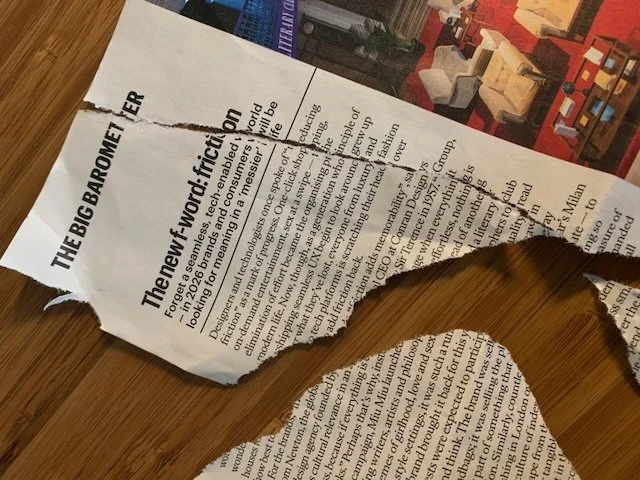
The new f-word: friction
The title that caught my eye (and Theo’s taste buds) was ‘The new f-word: friction’. If you can’t make it out in its torn-up state, here’s the opening paragraph:
Designers and technologists once spoke of “reducing friction” as a mark of progress. One-click shopping, on-demand entertainment, sex at a swipe – the elimination of effort became the organising principle of modern life. Now, though, as a generation who grew up worshipping seamless UX begin to look around and wonder what they’ve lost, everyone from luxury fashion houses to tech platforms is scratching their head over how best to add friction back.
(Alexandra Jones, Sunday Times)
This itchy little concept now keeps popping up with irritating frequency. Just last week, a webinar on AI in higher education concluded with a provocation that AI might be making some tasks so easy that friction needed to be re-introduced (cue chorus of approval from the academics in the audience). Wind back further to 2024, and we realise this is not a new discussion: the concept of ‘desirable difficulties’ in learning was a key topic at a university forum I attended on students’ experiences of learning, highlighting tensions between learning that feels good, and learning that has long-term impact.
So which is it? Are we still trying to create frictionless user experiences and smooth student journeys, or is there something about the hurdles and potholes we should be paying more attention to?
‘Friction-maxxing’ and the privilege of discomfort
Thanks to a viral article in January 2026 by freelance journalist Kathryn Jezer-Morton, the term ‘friction-maxxing’ has been bouncing around articles and podcast discussions for several months now. It joins various other types of -maxxing (sleepmaxxing, studymaxxing, etc.) which refer to an obsessive behaviour, ‘the practice of optimising a specific aspect of one's life, often to an extreme degree’ (thanks, Merriam-Webster). In Jezer-Morton’s version, however, ‘friction-maxxing’ is a little softer, more about pushing back on our one-click, next day delivery lifestyles and encouraging more mindful, intentional activities. Examples include using maps instead of GPS, reading books (not summaries!) and doing any number of tasks without turning to AI bots for quick answers.
So far, no major issues – few would disagree we could all do with a little less time on tech. However, it’s easy for concepts like these to lose context, and in this case, for “let’s increase friction, because life is too convenient” to slide into unhelpful assumptions and generalisations about ‘character-building’ and resilience.
For many university students, life is not too convenient. If you’re a first-in-family student navigating an enrolment system that assumes prior knowledge nobody told you, there’s plenty of friction right there. If you’ve commuted two hours to campus, you’re less likely to experience the morning tutorial discussion as a gentle intellectual warm-up, and more like the tail end of an exhausting logistical operation. And for the single parent sitting down to study at 10pm after a full day at work and getting the kids to bed? Telling them to add more friction to their lives is not a thoughtful provocation; it's assuming privileges these students don’t have.
Bumps vs. barriers: unequal frictions
It's worth drawing a distinction between different types of friction – let’s call them ‘bumps’ and ‘barriers’:
‘Bumps’ are small hurdles that slow us down, make us think, and in the right context, might even be part of the point; they’re uncomfortable, but you can get over them.
‘Barriers’, on the other hand, are obstacles that don't build resilience or deepen learning, but rather exclude, exhaust, or discourage the people who encounter them.
You’ll see both throughout the student journey, and conflating them is where well-intentioned conversations about friction can be unhelpful. Take the transition into university, for example. Some of the disorientation that comes with starting a degree might reasonably be called ‘bumps’: learning how an institution works, developing your student/ professional identity, figuring out how to engage in class discussions – that temporary uncertainty is part of what it means to enter a new learning community. But when a student can't get a response from an administrative office for three weeks, or when the support services they need have a 6-week waiting list, or the campus doesn't have the facilities to support a disability – that's a barrier, not a rite of passage.
Or consider the experience of researching an assignment. A student who has to hunt through a library database, refine search terms, and discard a few dead ends before finding a useful source is experiencing a bump. It's hard work, and that effort is arguably the whole point, with knowledge and understanding slowly building in exactly those moments of productive struggle. The barrier appears when that same database is hard to access, or when the student's first language isn't the one all the good sources are written in, or when no one has ever explained what a peer-reviewed journal article actually is. Same task, same moment in the journey, but a very different experience depending on where you started.
The distinction matters, because the responses are different. Bumps are often easy enough to smooth when we choose to, and sometimes, as the friction-maxxers would remind us, we might reasonably choose not to. Barriers, on the other hand, tend to be indicators of something deeper: of systems designed, consciously or not, around a particular kind of student. That doesn't mean we throw our hands up — quite the opposite. It means that when we find a barrier, we don’t just ask how we might fix it, but stop and consider what it tells us about who the system was never designed for in the first place.
Choose your friction: Theo and the rescue greyhounds
Which brings us back to Theodore, and the fragment of newspaper he helpfully liberated from a pile that had been sitting on the shelf for longer than I'd like to admit.
When we decided to foster greyhounds, we didn't simply turn up and collect a dog. Greyhound Rescue asked for photos of our home, information about who lived in it, our routines, our lifestyle. They wanted to know if we had other pets, small children, a busy household or a quiet one. And then, crucially, they didn't just allocate us whoever happened to be available, they matched us. They read our application, checked it against the dogs and their personalities, and sent us Theodore: a long, lean, sweetly chaotic canine who slotted into our household like he’d lived there all his life. The process has friction built deliberately into it – not to deter people, but to ensure that when a placement is made, it has the best possible chance of becoming permanent.
When the unexpected frictions arrive, from the bewildering first night to the creative destruction of your notebook collection, the rescue organisation is there. One-to-one support, thoughtful resources, a warm community of people who have all stood in their kitchen at 11pm wondering why their hound is doing that.
It's a small example, but here is an organisation funded entirely by donations and volunteers that could, in theory, have streamlined the whole thing. A quick form, a fast match, frictionless delivery of dog to doorstep. Instead, they chose to make it appropriately effortful, and the result is better outcomes for the animals, better-prepared adopters, and if the Facebook group is anything to go by, an extraordinarily devoted community of people who feel that their dog chose them, not the other way around.
That's the thing about friction. It isn't inherently good or bad – it's a question of what kind of friction, why it’s there, and who is impacted. A process made more intentional and considered is not the same as a process made unnecessarily hard. And a life with the right kind of texture in it – with books read to their actual endings, or a teacher who stops you after a tutorial to check in, or even a large, affectionate animal redistributing your newspaper archive – is not a worse life. It might even be a richer one.